Drawing curly hair can be a fun and creative process. This guide will provide you with practical techniques to capture the texture and movement of curls, making your artwork more dynamic.
With a few simple steps and some practice, you can master the art of drawing curly hair, whether for portraits, character design, or illustrations.
Techniques for Drawing Curly Hair
Capturing the essence of curly hair in your artwork requires a keen understanding of its unique characteristics.
This guide focuses on essential techniques that emphasize the shape, volume, and flow of curls.
By mastering these methods, you can create dynamic and realistic representations of curly hair in your illustrations.
Gather Your Materials
Before starting your drawing, ensure you have the right materials at hand.
A simple setup will suffice: a pencil for sketching, an eraser for corrections, and sketchbook or drawing paper for your work.
If you wish to add more detail, fine-tip pens or markers can be used for inking, and colored pencils or markers can enhance your final piece with color.
Start with the Basic Shape
Begin your drawing by lightly sketching the outline of the head and the general shape of the hair.
Curly hair typically has a rounded silhouette, so keep this in mind as you outline.
This foundational shape will guide the placement of the curls as you progress.
Draw the Curls
Next, focus on sketching the curls themselves.
Use loose, flowing lines to create a variety of curl sizes and shapes, which adds visual interest to your drawing.
Remember that curls often overlap and intertwine, so allow your lines to reflect this natural movement.
Add Volume and Refine Your Lines
To give your drawing more dimension, add additional lines around the curls to indicate thickness and volume.
Observe how the curls fall and layer over each other, and replicate this in your sketch.
Once satisfied with the overall shape, go over your initial sketches with a darker pencil or pen to define the curls and add finer details.
Don’t forget to erase any unnecessary lines to keep your drawing clean.
Add Texture and Color
Texture is key to making your curls look realistic.
Use short, quick strokes within the curls to suggest individual strands of hair.
Vary the pressure on your pencil to create lighter and darker areas, enhancing the depth of your drawing.
If you choose to add color, consider using different shades to highlight the curls and bring your artwork to life.
Practice and Tips for Improvement
To improve your skills, observe real curly hair for reference.
This will help you understand how it moves and reflects light, which is crucial for realistic representation.
Practice drawing various types of curls, from loose waves to tight ringlets, to expand your artistic repertoire.
Experiment with different drawing tools to discover what feels most comfortable and effective for you.
Techniques for Drawing Curly Hair
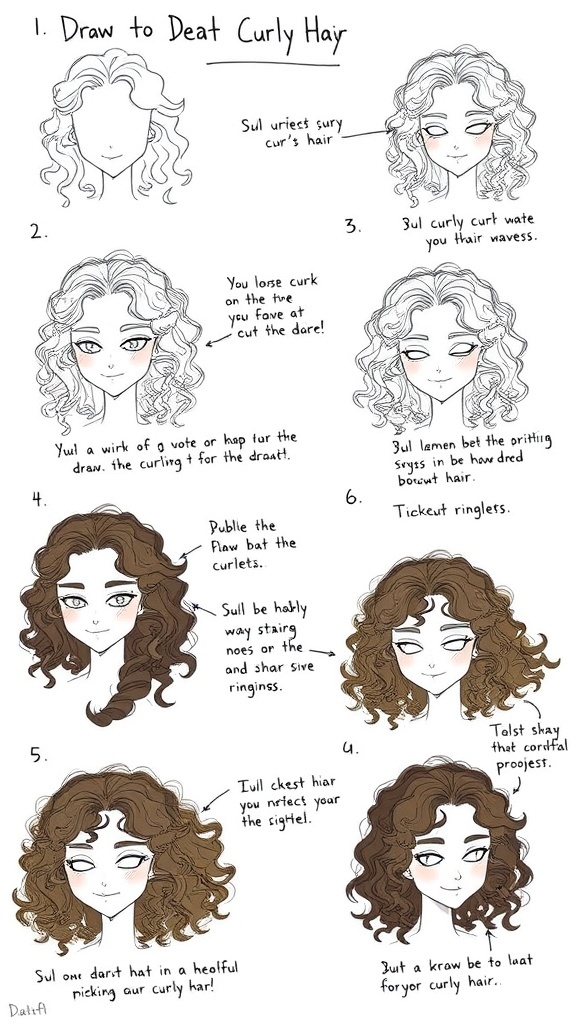
This guide covers essential techniques for drawing curly hair, focusing on the shape, volume, and flow of curls. The process involves sketching basic shapes, adding details, and refining your lines to achieve a realistic look.